
Overview
Message from the Program Director
Amid Japan’s declining birthrate and aging population, the Ministry of Health, Labour and Welfare (MHLW) and the Ministry of Economy, Trade and Industry (METI) are spearheading efforts to develop and implement care technologies, with a focus on care robots. However, present-day care technologies do not adequately reflect the convenience needs of users—comprising patients, family members, and healthcare/long-term care professionals. To successfully implement care technology, including care bots, into society, it is crucial to build an ecosystem that develops and implements these technologies through co-design with users and industry professionals, continuously validating needs and usability. In response, we have launched the "CareTech Master" Educational Program—a training initiative to cultivate professionals capable of advancing the development and societal implementation of care technology that supports individuals in living their lives on their own terms, maintaining autonomy and independence until the end, through the establishment of an ecosystem platform.
The program has been selected for the Ministry of Education, Culture, Sports, Science and Technology’s FY2024 Supplementary Budget "Recurrent Education Ecosystem Construction Support Project" and has launched as the "CareTech Master Educational Program for the Development and Implementation of Care Technology."
The CareTech Master Educational Program is designed to enable participants to envision future society from a care perspective and to acquire the essential competencies required of CareTech Masters. These include a "common language," "dialogue and conflict resolution," "interprofessional collaboration practice," "co-design," and "implementation strategy"—all crucial for both users of care technologies and industry professionals.
The program is structured to deepen learning progressively through "Foundation Course 1," "Foundation Course 2," and "Workshops." Furthermore, to accommodate busy working learners, instruction primarily consists of on-demand e-learning using video materials, each lasting 15 minutes. In addition, the program is supplemented by in-person group work and workshops, creating a framework where participation fosters cross-industry networking, connections, and practical collaboration skills.
In recent years, interprofessional collaboration has been deemed indispensable in healthcare and nursing care settings. However, collaboration between healthcare professionals and industry professionals remains largely unexplored. A cultural divide seems to exist between healthcare/long-term care professionals and industry professionals.
Against this backdrop, the CareTech Master Educational Program aims to build an ecosystem by providing a forum for users and industry professionals to learn together, fostering mutual growth and development.
About the CareTech Master Educational Program
The "CareTech Master Educational Program for the Development and Implementation of Care Technology" was launched following its selection for the Ministry of Education, Culture, Sports, Science and Technology’s FY2024 Supplementary Budget "Recurrent Education Ecosystem Construction Support Project."
The program aims to cultivate CareTech Masters and contribute to the growth of the entire care technology industry, including the healthcare sector. The term "care technology" in this context encompasses not only care robots but all technologies, robots, systems, applications, devices, etc., that contribute to human well-being.
The learning objectives achieved through program participation are the following:
- To acquire cutting-edge care knowledge and be able to envision future society from a care perspective
- To acquire the latest knowledge on the common language necessary for development and implementation, dialogue and conflict resolution, interprofessional collaboration practice, co-design, and implementation strategy frameworks, and to understand the necessity of developing and implementing care technology that can be sustainably utilized in healthcare and long-term care settings
- To be able to reform business development related to development and implementation through interprofessional collaboration practice between healthcare/long-term care professionals and industry professionals
Program Learning Content
In Foundational Course 1, titled "The Vision for Future Care Society," students learn fundamental knowledge for envisioning future societies and the latest advancements in care. Foundation Course 2, titled "Co-Design and Implementation Strategy for Care Technology," focuses on understanding the needs and seeds of care technology, acquiring a common language, and recognizing the necessity of co-design and implementation strategy frameworks. Furthermore, the workshop, titled "Developing and Implementing Care Technology: A Collaborative Approach by Users and Industry Professionals," allows participants to apply the knowledge gained in Foundation Courses 1 and 2 to experience formulating strategies for developing and implementing care technology. The workshop also enables participants to enhance their interprofessional collaboration skills by working in groups that combine users (healthcare and long-term care professionals) and corporate professionals.
To evaluate whether participants have mastered the learning content of the program, a competency rubric has been developed. For details, please visit the Competency Rubric page.
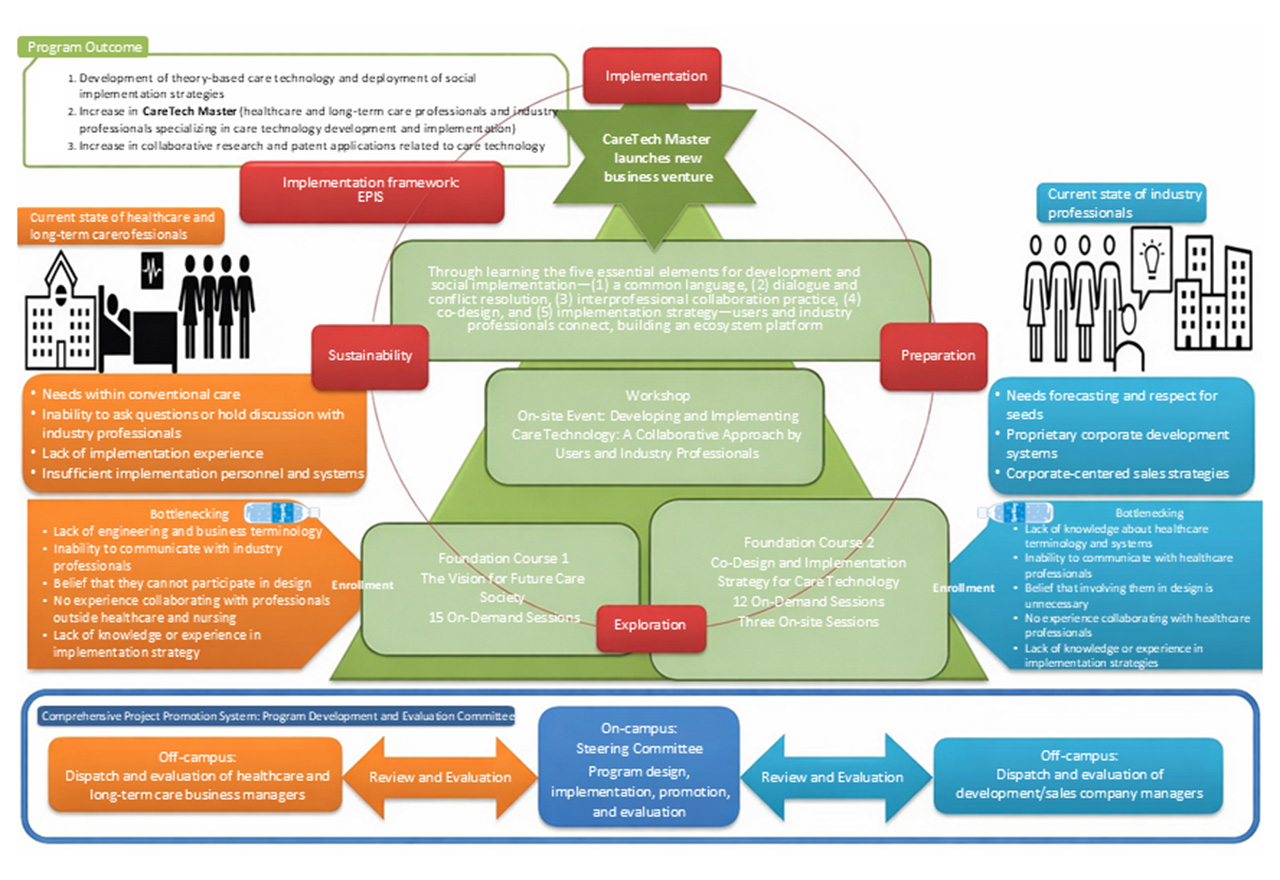
The program contributes to addressing Japan's societal challenges such as declining birthrates, an aging population, and a shrinking workforce. It aims to reduce the burden on healthcare and long-term care professionals, improve the quality of care, and enhance labor productivity through reskilling and lifelong learning for working adults by advancing the development and implementation of care technology.
Moving forward, plans include further expanding the practical applications of CareTech Masters through initiatives such as establishing a "Practical SD Program for Training CareTech Masters (Certificate Program)," creating a "CareTech Master Training Program within the Master’s Program of the Graduate School of Nursing," and establishing "National Hubs for CareTech Masters for Communication and Network Building."
Steering Committee Members
-
Hiroaki Ozawa Executive Vice President for Education, Chiba University
-
Hiroya Takeuchi Vice President for Educational Reform and Learning Support, Chiba University
-
Sayuri Suwa Professor, Graduate School of Nursing
-
Tomoko Majima Professor, Graduate School of Nursing
-
Ikuko Sakai Professor, Graduate School of Nursing
-
Shinichiroh Yokota Professor, Graduate School of Nursing
-
Motoshi Ouchi Professor, Graduate School of Nursing
-
Ayumi Igarashi Professor, Graduate School of Nursing
-
Yu Wenwei Professor and Director, Center for Frontier Medical Engineering
-
Masaharu Takahashi Associate Professor, Center for Frontier Medical Engineering
-
Daisuke Katagiri Professor, Entrepreneurship Center
-
Hitomi Ayuzawa Vice Directo, Nursing Department, Chiba University Hospital