
Competency Rubric
What is a Competency Rubric?
Developed in the United States, a rubric is a method for creating learning assessment criteria. It consists of "criteria" (assessment levels) and "descriptions of characteristics" that indicate when each criterion is met. By clarifying achievement levels through these descriptions, rubrics are well-suited for qualitative assessments of performance—such as skills—that are difficult to evaluate through other means, such as tests (1).
By presenting evaluation criteria in advance as a competency rubric and visualizing the assessment perspectives, learners can study proactively with clear goals (2).
CareTech Master Competency Rubric
Amid a society where the widespread adoption and advancement of technology continues to expand, specific indicators of the competencies required for CareTech Masters to fulfill their roles are essential. For this reason, this program has developed a competency rubric.
The competencies required of CareTech Masters comprise five domains: "Understanding the necessity of care technology and the latest knowledge," "Building a vision," "Cultivating ethical awareness," "Practicing interprofessional collaboration across industries," and "Development and implementation." These five domains are based on the Exploration, Preparation, Implementation, and Sustainment (EPIS) implementation framework. The EPIS framework is one of the most-flexible and most-widely used implementation science frameworks. The framework considers the complex healthcare systems, organizations, and community environments in which nurses work, making it particularly useful in healthcare and long-term care settings. It includes: a) four stages (exploration, preparation, implementation, sustainment), b) four domains (external context, internal context, bridging factors, innovation factors), and c) interconnectedness, interactions, and relationships that can influence the implementation process, strategy, and outcomes (see Reference (3) and Website (4) for details).
The four stages of EPIS are considered useful for continuously structuring activities toward sustainability in implementation. From the perspective of its relationship with the CareTech Master Educational Program, the "exploration" stage includes "the necessity of care technology and the latest knowledge," while the "preparation" stage encompasses "building a vision" and "cultivating ethical awareness." The "implementation" stage requires "development and implementation" and "practicing interprofessional collaboration across industries." Furthermore, the "sustainment" stage involves all five domains. We believe that the capabilities of CareTech Masters are realized through the sequential interconnection of each domain.
The competency rubric systematically outlines the stages of learning and mastery for these competencies across four levels: C: Acquired as knowledge; B: Able to explain acquired knowledge; A: Able to apply knowledge and skills to solve problems in practice; and S: Able to develop knowledge and skills and instruct others.
Furthermore, in developing this rubric, we also referenced the concept of "Essential Competencies for the 100-Year Life" published by the Ministry of Economy, Trade and Industry (METI) (5). These "Essential Competencies for the 100-year Life" are defined as the abilities required to continue thriving throughout each life stage within increasingly prolonged individual engagement with companies, organizations, and society. The content comprises the three core competencies and 12 competency elements of the foundational skills for working persons, shown below, approached through three new perspectives. It is crucial to recognize oneself based on these three competencies, engage in reflection, and balance the three new perspectives (purpose, learning, and integration). We believe this program provides an opportunity to acquire these skills through its learning process.
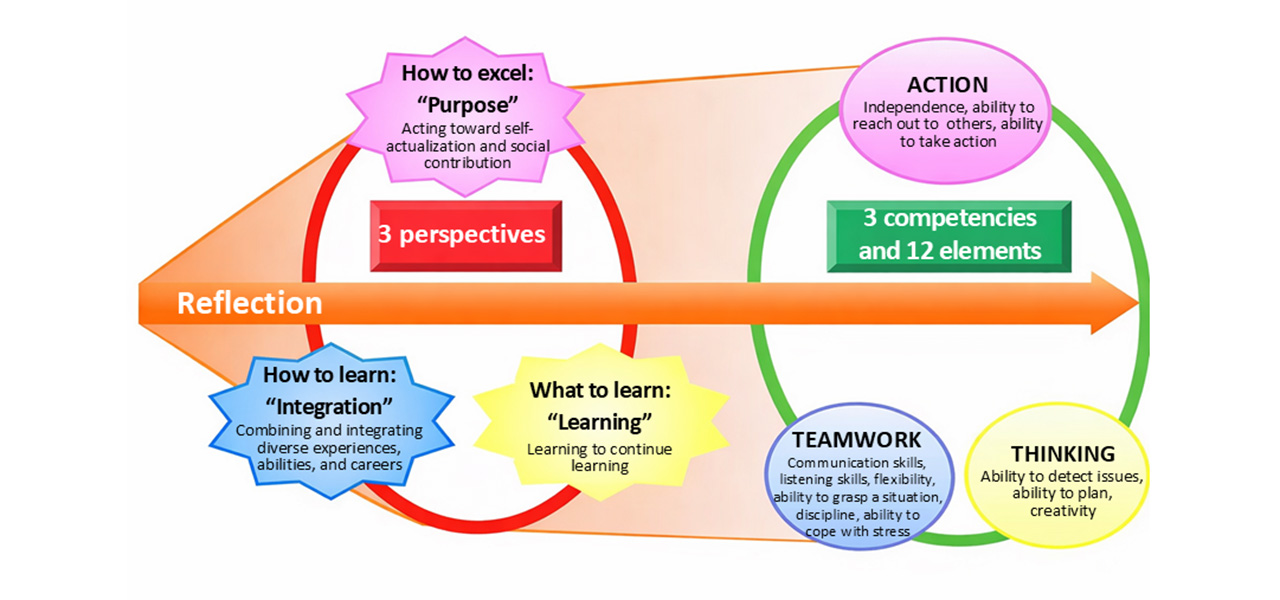
| Three competencies | ACTIONThe ability to take a step forward and make steady efforts even if you fail | THINKINGThe ability to think through the doubts you may have | TEAMWORKThe ability to work with diverse people toward a goal |
|---|---|---|---|
| 12 elements |
|
|
|
Citations and References
- (1)Central Council for Education "Towards a Qualitative Transformation of University Education for Building a New Future - Universities Fostering Lifelong Learning and the Ability to Think Independently and Proactively" (March 2012) (summary of report in English)
- (2)(2)From the explanatory materials of Atsushi Hamana, member of the Higher Education Subcommittee of the Central Council for Education (President of Kansai International University) (in Japanese only)
- (3)Gregory A. Aarons, Erika L. Crable, Ryan Kenneally, Marisa Sklar, and Joanna C. Moullin translated by Ikuko Sakai and Masatoshi Saeki "The Exploration, Preparation, Implementation, and Sustainment (EPIS) Framework: Utility for Implementation Science and Nursing Research," Japanese Journal of Nursing Research 2024; 57 (3): 287
- (4)EPIS Framework
- (5)Ministry of Economy, Trade and Industry (METI) "Fundamental Competencies for Working Persons" (website in Japanese only)